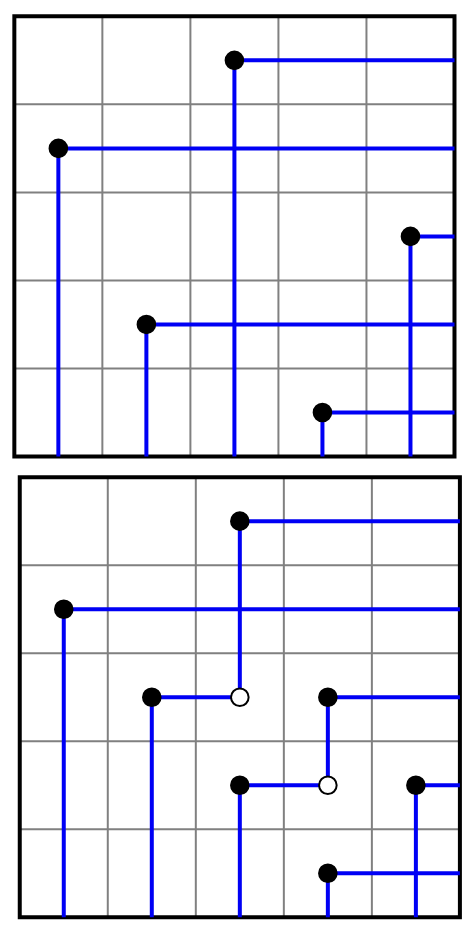
The SYZ conjecture posits that special Lagrangian fibrations provide a geometric explanation for mirror symmetry.
On the purely symplectic side, non-special Lagrangian torus fibrations provide a useful framework for understanding the geometry of symplectic manifolds.
However, there is no general theory of these fibrations in dimensions higher than four, in part due to a dearth of examples.
This limits many applications to four dimensions.
In this talk, I will present my work on constructing Lagrangian torus fibrations in all dimensions.
I will show that many complete intersections in toric varieties admit such fibrations.
For example, Batyrev-Borisov mirror pairs have dual Lagrangian torus fibrations.
I will also show that all Fano threefolds admit Lagrangian torus fibrations with base the three dimensional ball.
The moduli space of smooth hypersurfaces in projective space
can be constructed as a GIT quotient by linear changes of coordinates,
and it comes with a natural GIT compactification. In certain degrees
and dimensions, Hodge theory provides a second compactification via
the period map, namely the Baily-Borel compactification. Building on
recent progress on higher singularities and a new stability criterion
formulated in terms of the minimal exponent (a refinement of the log
canonical threshold), I will discuss the birational geometry of these
two compactifications and describe consequences for the boundary
behavior of the period map.
Finding a border rank decomposition for a tensor is often a delicate balance between "science" and "art".
On one hand, if the tensor has enough structure, one can exploit various dictionaries between these tensors and well-studied structures in algebraic geometry to prove upper bounds on its border rank.
On the other, as far as we are aware, all other border rank decompositions previous to this work are presented with no explanation.
Using a fundamental invariant of a tensor called the centroid, we discuss tools to systematically approach finding border rank decompositions for any tensor, even those with little to no structure.
As applications, we introduce new tensors with large centroids and prove that they have minimal border rank, and we also find new, lower order decompositions for other important tensors, one of whose older decompositions had previously been state-of-the-art for 40 years.
A main goal of this talk is to be very accessible and introduce many examples.
This is joint work with JM Landsberg (Texas A&M), Martin Kassabov (Cornell), and Victor Souza (Cambridge; Cornell).
Viehweg hyperbolicity addresses the question of relating the
positivity properties of the fibers of a family of algebraic varieties
to positivity properties of the base. We will introduce this circle of
ideas that goes back to work of Beauville in 1981. In particular, I
will discuss my joint work with Sebastian Casalaina-Martin on Viehweg
hyperbolicity for DM stacks. We will focus on the motivation and
examples.
We will discuss scalar curvature from the point of view of metric invariants. In particular, we will describe a new estimate for the codimension two width of circle bundles, and explain how it leads to counterexamples to the macroscopic version of Gromov’s Urysohn width conjecture, in dimensions four and higher. Based on joint work with Balarka Sen.